 MIGRATING CARIBOU
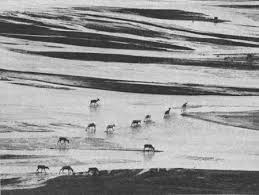 “Migrating Caribou”
The first passage explains about the migration of the caribou. In summer, these animals eat grasses on the tundra near the Arctic Circle. When the weather gets colder, they form massive herds and head hundreds of miles south to spend winter in the forests. In the spring they head north again, as far as the North Pole, to have their young. As summer approaches, the animals complete the migration cycle by again heading south to the grassy tundra.
Animals That Travel (Salmon Migration )
Animals That Travel - Salmon Migration
The second passage gives facts about the migration routes of different animals and suggests how animals find their way. In addition to using the sun, stars, or landmarks,
scientists think some animals might have compasses inside their bodies to help
them find their way as they migrate.
Key Words
• biologists: scientists who study living things
• herd: a group of a particular type of animal
that lives together
• journey: a long trip from one place to
another, usually over a great distance
• landscape: a view across an area of land
• magnetic: having the power of a magnet
• starvation: suffering or death caused by not
having enough to eat
Academic Words
approaches = moves closer
migrate = move from one place to another
sufficient = as much as one needs; enough
transport = move or carry goods from one
place to another
Prenominal and Postnominal Adjectives
- A prenominal adjective precedes, or appears before, the noun it modifies. In English, most adjectives are prenominal.
- A postnominal adjective appears after the noun. Postnominal adjectives modify indefinite pronouns such as something, anybody, everyone, and nothing.

No comments:
Post a Comment